The Elephant Catchers by Bagchi Subroto
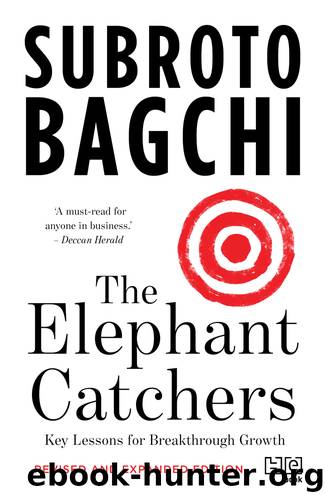
Author:Bagchi, Subroto
Language: eng
Format: epub
Publisher: Hachette India
Published: 2017-08-28T00:00:00+00:00
14THE FORCE OF GOOD
CSR initiatives donât just make businesses credible. They have greater benefits. They awaken the power of inclusion and volunteerism among employees, which rub off on the way they approach their work.
ON THE THIRD SATURDAY of every month, a bus leaves Mindtreeâs office in Bengaluru in the morning, picking up volunteers from designated points in the city. It makes three stops: one at a childrenâs home, another at a home for the destitute and, finally, at a centre for patients suffering from HIV/AIDS. The three homes are run by the Missionaries of Charity. The objective of the occupants of the bus is to give the Charityâs sisters a few hoursâ break from their routine. They carry food and help clean up the place. Sometimes they give the inmates a haircut, or play music for them, and sometimes they take along small items like bangles and trinkets and new clothes. For these software engineers, it is not about doing good. It is about being good. When we thought of starting Mindtree, we had envisioned a company with a social conscience. The monthly bus trip and a dozen other activities that we engage in around the world are a part of this idea. Voluntary work with schools, civic bodies and not-for-profit organizations keeps us connected with larger social issues beyond the everyday lives at the workplace.
In post-independence India, corporate social responsibility (CSR) was an amalgam of what industrialists like Ghanshyam Das Birla, Jamsetji Tata, Lala Shri Ram, Gujarmal Modi and others like them typified. They built temples, dharamshalas and educational institutions, sponsored artists and music festivals. Some got into active community development with specific focus on areas like adult education and family planning, like the well-known Tata initiatives in Jharkhandâs tribal belts. Most such work that was traditionally done in India had distinct characteristics. First, such activities did not flow from an overall, articulated corporate mission that bound everyone in the organization. Usually, CSR was about what the owner engaged with and seldom galvanized the collective power of people to make a larger social impact or gave employees an opportunity to view the workplace as a unit of society. Second, the Indian model had little to do with governance. For example, a company could be getting raided for income tax or excise duty evasion and at the same time be known for building dharamshalas as a contribution to society. Third, the concept of CSR had an angle of âcharityâ as against building an organizational culture of volunteerism. Finally, CSR as a concept had nothing to do with the organizationâs philosophy towards its customers. A company in a protected economy could be building schools and colleges but continue to create poor products and services because the customer had no choice but to buy it. An automobile company, for instance, could be doing great charity work while its products continue to not meet emission standards.
Today, CSR has come to mean something else entirely and it is imperative for organizations to adopt it.
Many companies the world over have made CSR a part of their mission, vision and values.
Download
This site does not store any files on its server. We only index and link to content provided by other sites. Please contact the content providers to delete copyright contents if any and email us, we'll remove relevant links or contents immediately.
The Brazilian Economy since the Great Financial Crisis of 20072008 by Philip Arestis Carolina Troncoso Baltar & Daniela Magalhães Prates(131826)
International Integration of the Brazilian Economy by Elias C. Grivoyannis(106924)
The Art of Coaching by Elena Aguilar(53129)
Flexible Working by Dale Gemma;(23280)
How to Stop Living Paycheck to Paycheck by Avery Breyer(19680)
The Acquirer's Multiple: How the Billionaire Contrarians of Deep Value Beat the Market by Tobias Carlisle(12297)
Thinking, Fast and Slow by Kahneman Daniel(12205)
The Radium Girls by Kate Moore(12000)
The Art of Thinking Clearly by Rolf Dobelli(10376)
Hit Refresh by Satya Nadella(9101)
The Compound Effect by Darren Hardy(8901)
Tools of Titans by Timothy Ferriss(8345)
Atomic Habits: Tiny Changes, Remarkable Results by James Clear(8302)
Turbulence by E. J. Noyes(8000)
A Court of Wings and Ruin by Sarah J. Maas(7778)
Change Your Questions, Change Your Life by Marilee Adams(7715)
Nudge - Improving Decisions about Health, Wealth, and Happiness by Thaler Sunstein(7676)
How to Be a Bawse: A Guide to Conquering Life by Lilly Singh(7455)
Win Bigly by Scott Adams(7164)
